Italy
Italy
 Germany
 Netherlands
 Croatia
 Denmark
 Finland
 Greece
 Portugal
 Sweden
 Norway
 Bulgaria
 Estonia
 Latvia
 Lithuania
 Poland
 Czech Republic
 Romania
 Slovakia
 Slovenia
 Hungary
 Spain
Spain



This document is intended to briefly present the three most commonly used electric arc welding processes, particularly by hobbyists:
- The MMA (111) process,
- The TIG DC or AC process (141),
- The MIG (131) / MAG (135) process.
1 - The MMA process (Manual Metal Arc - 111)
It is the best known, the simplest, the most widespread. Initially consisting of a simple transformer providing alternating current, modern welders are now most often of the "inverter" type, using power semiconductors that provide many advantages: direct current allowing the polarity to be adapted to the electrode type, higher open-circuit voltage, better intensity regulation, assistance devices such as arc force and anti-stick. This process uses coated electrodes (commonly called "rods") of 1.6 to 4 mm in diameter most often. The only adjustment to be made on these welders is the intensity according to the electrode diameter. This process is suited to the everyday work of the hobbyist, mainly on steel for thicknesses of approximately 2 to 10 mm. Sometimes more (in multiple passes), but rarely less.
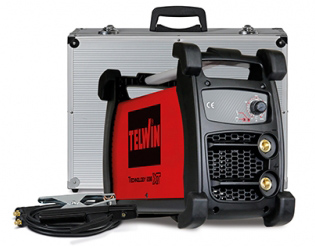 Example of an MMA welder
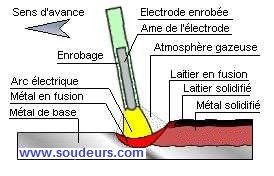 MMA welding principle
Note: As a reminder, the flux-cored wire process (114, semi-automatic without gas) is related to MMA, with the electrode replaced by a continuous wire that unwinds. In this case, the primary setting is the wire feed speed. This process can be an alternative to MAG for rough work, particularly when welding outdoors.
2 - The TIG process (Tungsten Inert Gas - 141)
This process uses a current generator similar to that of MMA (regulated by intensity) but the arc is produced between the workpiece and a non-consumable tungsten electrode, under the protection of a neutral gas (generally pure argon) with the addition of a filler metal in the form of rods of appropriate diameter and the same nature as the metal being welded. In this respect, the TIG process can be compared — due to the use of both hands — to autogenous torch welding or brazing.
The TIG process allows very clean and very precise welds to be made, without spatter, fumes, or slag, on very thin thicknesses (< 1 mm) of metals of all types.
Please note however: There are two types of TIG welders:
- DC (direct current) for steel, stainless steel, and possibly copper,
- AC/DC (direct or alternating current) also allowing the welding of aluminum alloys.
The price of a TIG welder varies greatly: very affordable for the simplest DC models, up to much higher prices for AC/DC welders offering numerous settings.
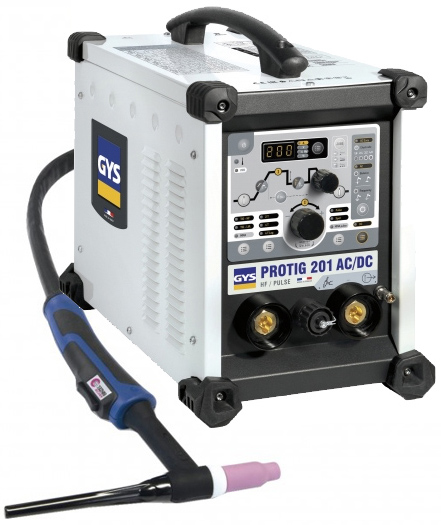 Example of a TIG welder
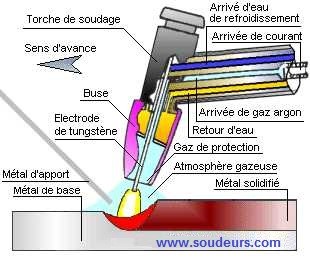 TIG welding principle
Note: MMA and TIG DC welders being based on the same current generator, any TIG welder allows MMA welding. Conversely, it is possible to weld with TIG DC using an MMA welder, provided a valve torch is used to manually control the argon flow rate. However, the absence of any adjustment other than intensity, contact arc starting, gas waste, and user discomfort limit this option to exceptional use.
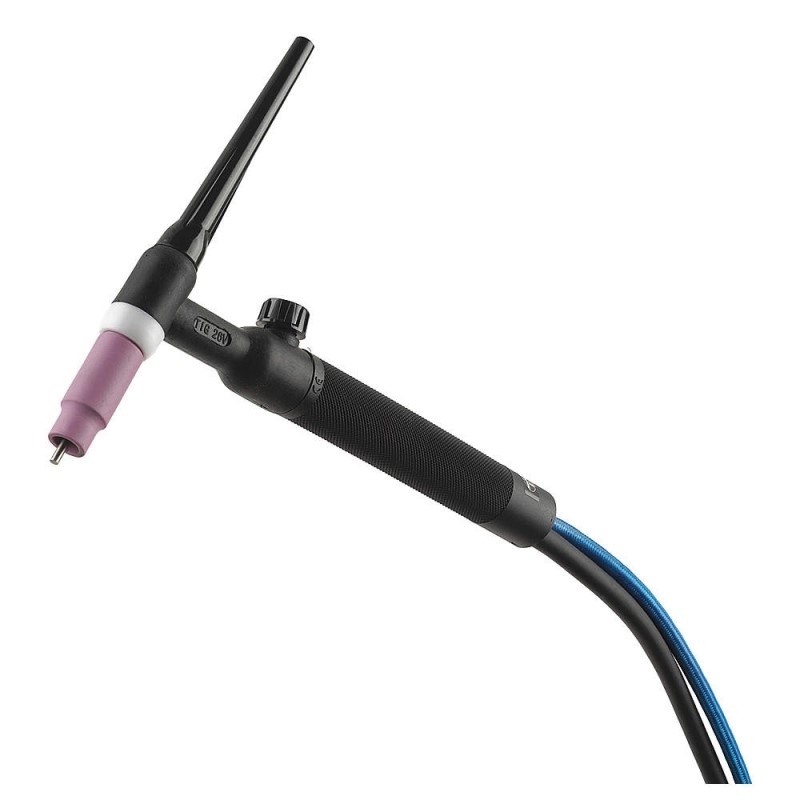 Example of a valve torch
3 - The MIG (Metal Inert Gas - 131) / MAG (Metal Active Gas - 131) process
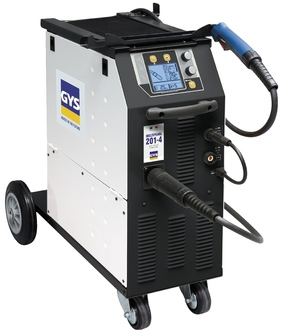
These so-called "semi-automatic" processes use a particular current generator (voltage-regulated) and a filler metal in the form of wire on a spool, unwound at the appropriate speed. The relatively complex settings (voltage and wire speed) of these welders are sometimes made easier for beginners by assistance features known as "synergic mode". Unlike the TIG process, the gas used differs depending on the metal being welded:
- Pure Argon for aluminum alloys (MIG),
- Argon with 2% CO² for stainless steels (MAG),
- Argon with +/- 12% CO² for low-alloy steels (MAG).
This requires having several gas cylinders depending on the metal being welded. The torch liner and feed rollers must also be adapted accordingly.
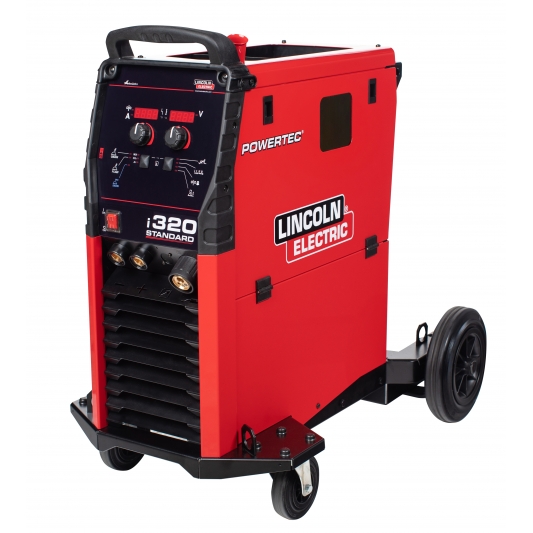 Example of a MIG-MAG welder
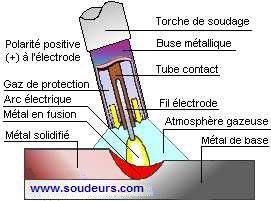 MIG-MAG welding principle
Note 1: Some entry-level semi-automatic welders do away with the "Euro" connector for the torch, which notably complicates interventions on the liner and prevents quick torch changes.
Note 2: As the current generator is designed differently from that of an MMA or TIG welder, few semi-automatic welders are genuinely capable of welding with coated electrodes (assuming the necessary connectors are present).
4 - Multi-process welders (for reference)
Since there is a market for it, welders are available that can weld in MMA mode, TIG DC (with restrictions), and semi-automatic MIG/MAG. Only certain models handle this difficult exercise well; sharing experience helps identify those that have proven themselves. Keep in mind that in the event of a breakdown, such a device leaves you without any means of welding.
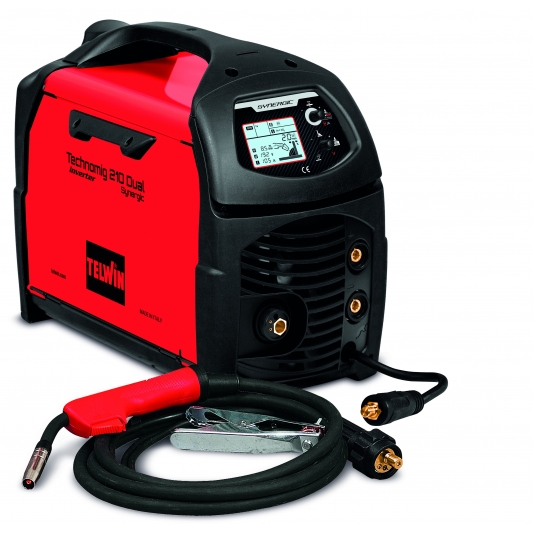 Multi-process welder